The Giving Tree and Society

By Tieg Summers
There is something special to be said about trees. Trees feed us with delicious fruits and nutritious nuts. Trees provide us with wood for building houses and wood for burning fires to keep people warm or to cook our fish as well as providing us with a way to toast marshmallows. Trees also shelter people from the rain and shade us from the sun. Is it crazy to say that we survive from trees? You can even take a quiz to see what type of tree you are. I took this quiz and I am an Evergreen Pine Tree. Trees are important to our society.
For some reason, trees are my go to thing. When I want to paint or draw, I automatically know that I can create a tree and always be proud of my work. Where did/does my love of trees come from? Perhaps from a time when I was much younger and I owned a special book. The Giving Tree was my favorite book growing up. It is a simple book with black and white texts and drawings. The only thing of color is the colorful multi-green cover. The book is an easy read for anyone. The Giving Tree is about a boy who goes to a tree and plays with it. The tree gives it apples so the boy can sell them for money. As the boy gets older it keeps coming back to the tree. The tree gives the man branches so he can build a house and its trunk so the man can carve a boat. When nothing but the stub of the tree is left the boy just wants a nice quiet place to sit. Everyone can interpret the story differently but the main censuses comes down to giving unconditional love to something forever and always. Like how our Labrador Retrievers give us unconditional love and happiness, The Giving Tree provides as much as possible to the boy in the story and the tree expects nothing or asks for nothing in return. The Giving Tree is still one of my favorite books today. A book I plan on giving to my children and I desperately hope they get as much pleasure out of the book that I get. The adaptions, interpretations, and editions have allowed for the beautiful context of the book to spread throughout the world.
The Giving Tree was written and illustrated by Shel Silverstein and was first published and printed in 1964 by Harper and Row. The book was published in English, Hebrew, French, and a braille version was published in 1964 as well. In 1975 it was published in Korean and in 1976 it was published in Japanese. The book went on later to be published in German, Spanish, Chinese, Serbian, Slovenian, Croatian, Czech, Finnish, Catalan, Italian, Latin, etc. The first audio book was published in 2004. It was published as an ebook in 1993 and 2002 but none of these where in English. Besides the language changes in the book not much else has changed but the cover (worldcat.org). Even not much has changed in the cover besides the different shades of green that are used for the tree and the background. The book was made into an extremely short animated film in 1973 that represented the book exactly (watch the film here). This book has made such an impact on culture that the context has leaped out of the pages and jumped into other fields. There are many interpretations out there about what the book represents. Is the book about unconditional love? It is about embracing all you have and being happy with it? Is it about giving all you can to people? It is about a selfish little boy? Is it about friendship or about a mother taking care of a child? Perhaps it is about all of the above. Some may think that the tree represents God or perhaps Mother Nature teaching the boy about the environment. Some may think the book sends the right message but other may think it sends the wrong. It all depends on the way a person interprets the book. Below is a list of some adaptions of the book into society on many different media platforms.
Adaptions:
1. I’m Here (A Short Film)
Spike Jonze wrote and directed a short film called I’m Here which was released in 2010. (You can access the full movie here!). This adaptation of the story seems out of the same story world and completely different from the book but after seventeen minutes it finally starts to draws its connections back to the book. The short film is about a female robot and a male robot who fall in love. The girl ends up accidentally breaking off an arm and a leg, etc. leaving the boy to give her his body parts. Unlike the book, the receiver did not ask for the parts at all but the giver was happy to give them up without the girl asking. I think Jonze did a great job because this film really puts the books content more in perspective because we consider these robots to be human people capable of real emotions. The fact that a human is willing to give up their body means more than a tree willing to give up their body especially since we already take from trees so it means less to us. The relationship of the giver and receiver are different are different in both the book and the film. In the book, we consider that the tree is a parental figure who gives all she can to the boy. In the film, it is a romantic partnership instead of a parent/child or friendship relationship. Gender roles are flipped in the film because it is the male who gives to the female instead of a female figure giving to a male. I think these distinctions were made to more accurately reflect society norms.
2. The Plain White T’s Song “The Giving Tree”
The 2013 song “The Giving Tree” by The Plain White T’s uses The Giving Tree book as a metaphor for a love relationship. The singer claims he wants to be a girl’s “giving tree” but unlike the book he expects love in return and he is disappointed by the results. The song asks the question “why?” the receiver would take it all from him if the girl just wanted love as well. You can listen to the song and watch the music video here! The book has a lot to teach people about love and therefore people have adapted it from the book into a romantic relationship as we have seen from this song and the short film above.
3. The Giving Tree Band
The Giving Tree Band named itself after the book in 2004. What does the name suggest the band is all about? This band is all about environment stewardship from their lifestyle choices to their music to their community. The music of this American folk rock band can be found on major music programs like iTunes and Spotify. Check out their website to learn more about the band and the wonderful environmentally friendly things they do.
4. The Other Giving Tree (An Alternative Version of the Book)
An alternative version of the book was written in 1979 by Jacqueline Jackson and Carol Dell (accessed through JSTOR). This short version is about two trees. One tree gives everything to the boy (apples, branches, and its trunk) and the other tree stops after giving apples to the boy. The boy is selfish and angry that the other tree would not give up all her other elements to the boy. Later the boy was no longer upset when he realized he needed the shade from the other tree to shield him from the burning sun.
5. A Reading Garden: The Giving Tree Garden in Holon, Isreal
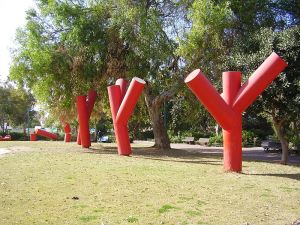
There is also a reading garden in Holon, Israel that was inspired by the children’s book. The garden encourages reading and provides a beautiful green space, with lots of trees (real and fake) for people to read around. The tree sculptures there were created by Buky Schwartz in 2002 (picture from pinterest with link). The great context of the book has transformed from a little boy in the story going to a tree to you (the reader) literally going to a tree (in the Holon garden) and reading the book. Who knows what kind of special feeling it is to read this book under a tree!
6. Products
And of course wonderful products have been produced to showcase the love of the book. Not every book created has products made after it so you know this book is special. You can get a computer decal for apple products because their apple logo fits perfectly with the cover of the book. The picture on the cover of the book is iconic for all Giving Tree products. This book has inspired companies to use The Giving Tree name because they want the name to appeal to buyers because of what the name can represent.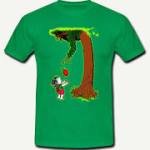
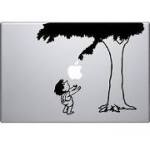
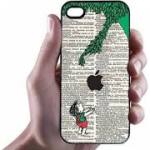
The book has inspired society to adapt it into its culture by the message it sends to people, especially to kids since it is considered to be a children’s book. But it sends different messages and meanings to different people who are free to interpret the book in whatever way despite what the title might try to tell you.
The Giving Tree has inspired me to want to develop a project in a needy community. This project would work like a community garden but instead of high maintenance plants, I would want a tree garden that would produce food for a community and provide people with a nice safe place to be in their community. This garden would take years to develop but it would last a really long time as long as the trees are healthy. The problems with a project like this include location and funding for getting started and then funding for the upkeep. This Giving Tree Garden would try to deliver the same message as I think the book did. To give unconditionally with nothing in return but like The Other Giving Tree it would stop at the food it produces. I would love to start a project like this on a site like Kickstarter. Not only would it be easier to require funds but to also get the word out about an idea like this so other communities can adapt it as well as to get the word out about how wonderful of a book The Giving Tree is and will forever be!
*This blog post was crafted for a class assignment.*
 Tieg's Turn!
Leave a comment